


What's Actually in Face Paint? Every Ingredient Explained in Plain English
If you have ever turned over a jar of professional face paint and wondered what you are actually reading, you are not alone. The ingredient list can be difficult to decipher — Polyvinylpyrrolidone, PEG-32, Acacia Senegal Gum. These are the formal scientific and Latin names that cosmetic regulations require on labels, and they rarely sound familiar.
But here is the reassuring truth: almost every ingredient in professional face paint is something you have already used on your child — or given them to eat — without a second thought. This guide breaks down each ingredient in the Fusion Body Art formula in plain language: what it is, what it does in the paint, and where else you encounter it every day.
The Full Fusion Body Art Formula
The complete ingredient list on Fusion Body Art face paints:
Calcium Carbonate, Acacia Senegal Gum, Glycerin, Polyvinylpyrrolidone, PEG-32, Water (Aqua), may contain: Iron Oxides (CI77491), Titanium Dioxide (CI77891), FD&C Yellow 5 (CI19140), FD&C Red 40 (CI16035), FD&C Blue 1 (CI42090), Ultramarines (CI77007), D&C Red 7 (CI15850), Mica (CI77019)
The list has two parts. The first six ingredients are the base formula — the ingredients that give the paint its texture, workability, and wearability regardless of colour. The "may contain" section lists the colour pigments — different colours in the range use different combinations from this approved list.
The Base Formula — Ingredient by Ingredient
These six ingredients are present in every Fusion Body Art face paint colour. They are what makes the paint feel smooth, apply evenly, stay put, and wash off cleanly.
| Ingredient | Natural or Synthetic | Role in the Paint | Safety Status |
|---|---|---|---|
| Calcium Carbonate | Naturally occurring mineral | Gives texture, body and opacity | FDA and EU approved. GRAS food additive. |
| Acacia Senegal Gum | Natural plant gum | Binds formula, helps paint adhere to skin | FDA GRAS. EU approved. Assessed safe in cosmetics by CIR. |
| Glycerin | Naturally derived from plant oils | Humectant — keeps skin comfortable and paint workable | FDA and EU approved. GRAS food additive (E422). |
| Polyvinylpyrrolidone (PVP) | Cosmetic-grade synthetic polymer | Film-forming agent — creates smudge-resistant finish | FDA approved for food, drug and cosmetic use. Extensively safety-tested. |
| PEG-32 | Synthetic polyethylene glycol | Conditioning agent — improves texture and blendability | Assessed safe for cosmetic use by CIR Expert Panel. |
| Water (Aqua) | Natural | Carrier and activator — enables water-activated application and clean removal | — |
1. Calcium Carbonate
Natural mineral. Gives the paint its smooth texture and opacity.
Calcium Carbonate is a naturally occurring mineral — one of the most abundant on Earth, found in chalk, limestone, and marble. In its purified, cosmetic-grade form it is an ultra-fine white powder that gives face paint its body and opacity. Without it, the paint would be thin and translucent rather than bold and covering.
It also acts as a gentle bulking agent that improves the feel of the formula on skin — contributing to the smooth, non-chalky application that professional face paints are known for. Calcium Carbonate is biodegradable and considered environmentally friendly among cosmetic raw materials.
2. Acacia Senegal Gum
Natural plant-based gum. Binds the formula and helps it adhere to skin.
Acacia Senegal Gum — also known as Gum Arabic — is a natural gum harvested from the dried sap of the Acacia Senegal tree, which grows across sub-Saharan Africa. It has been used in food and medicine for thousands of years, making it one of the most historically well-understood ingredients in the formula.
In face paint, it serves as the primary binder — the ingredient that holds all the other components together into a cohesive cake and helps the paint adhere to skin without feeling heavy or sticky. It also acts as a natural thickener, contributing to the creamy, workable consistency that professional face paints achieve when activated with water.
The Cosmetic Ingredient Review Expert Panel has assessed Acacia Senegal Gum and concluded it is safe for use in cosmetic products. The FDA classifies it as Generally Recognised As Safe (GRAS) for use in food. It is approved for use in baby products across Europe.
3. Glycerin
Plant-derived humectant. Keeps skin comfortable and the paint workable.
Glycerin — sometimes listed as Glycerol — is a naturally derived, simple, colourless, odourless liquid obtained from plant oils. It is one of the most widely used ingredients in skincare and personal care products globally. Its primary function is as a humectant: it attracts moisture from the air and helps retain it, which is why it appears in so many moisturisers and skin-soothing products.
In face paint, Glycerin serves two purposes. On the skin, it keeps the painted area comfortable and prevents the paint from feeling tight or dry as it sets. In the formula itself, it acts as a plasticiser — keeping the cake from becoming too hard or brittle in the jar, and helping the paint flow smoothly off the brush when activated with water. It is a significant contributor to the flexible, non-cracking finish that professional face paint achieves.
4. Polyvinylpyrrolidone (PVP)
Film-forming agent. Helps paint apply smoothly and dry to a smudge-resistant finish.
Polyvinylpyrrolidone — usually abbreviated to PVP — is a cosmetic-grade synthetic polymer with an impressive range of applications across medicine, food, and cosmetics. Despite the daunting name, it is one of the most thoroughly safety-tested ingredients in the cosmetic industry, with decades of clinical use supporting its safety profile.
In face paint, PVP is the film-forming agent — the ingredient responsible for that characteristic professional face paint finish where the paint dries to a slightly set, smudge-resistant surface. When the water in the formula evaporates after application, PVP forms a flexible, invisible film over the paint that helps it stay crisp and intact through a face painting event. It is a significant reason why professional face paint holds up better than cheaper alternatives under movement, warmth, and light perspiration.
5. PEG-32
Gentle conditioning agent. Improves texture and helps the formula blend evenly.
PEG-32 is a synthetic polyethylene glycol — a category of cosmetic-grade ingredients widely used in pharmaceutical, food, and cosmetic formulations. The "32" refers to the average molecular chain length. PEG-32 is a gentle, conditioning ingredient that functions primarily as a solvent and texture improver — it helps the other ingredients blend together evenly and contributes to the smooth, even spreadability of professional face paint on skin.
PEG ingredients have been assessed extensively by the Cosmetic Ingredient Review Expert Panel. PEG-32 in particular has been evaluated and found safe for cosmetic use at current concentrations. It is water-soluble, which is one reason why professional face paint washes off with warm water and soap without residue.
6. Water (Aqua)
The base that activates and controls the formula.
Water is the carrier that holds the formula in its cake form and the agent that reactivates the paint when a damp brush is applied. Professional face paint is water-activated — the small amount of water incorporated into the formula during manufacturing keeps the cake from cracking while leaving enough binding strength to hold the cake shape. When a damp brush is applied by the face painter, it reactivates the water-soluble ingredients and releases the paint.
The water-activated system is also the reason professional face paint washes off so cleanly — because the formula is designed to dissolve in water, warm water and soap will always remove it without harsh scrubbing.
The Colour Pigments — What "May Contain" Actually Means
The second part of the ingredient list is the "may contain" section. This confuses parents more than anything else on the label — it sounds like the product might randomly contain unknown substances. It does not.
"May contain" on a cosmetic label is the standard way of declaring colour pigments across a product range. Different colours require different pigment combinations — a red paint uses different pigments from a blue one. Rather than printing a different full ingredient list on every single colour, cosmetic regulations allow brands to list all the pigments used across their entire colour range with a "may contain" declaration, so you know exactly which pigments could be present in any colour.
Every pigment in Fusion Body Art's "may contain" list is an FDA-approved colour additive — individually reviewed and permitted for use in cosmetics. All FD&C and D&C pigments in Fusion Body Art paints are manufactured in the USA.
| Pigment | CI Number | Colour | Where Else You Find It |
|---|---|---|---|
| Iron Oxides | CI 77491 | Reds, browns, blacks, yellows | Mineral foundation, eyeshadow, lipstick, sunscreen — naturally occurring minerals and one of the most used pigments in all cosmetics |
| Titanium Dioxide | CI 77891 | White | Sunscreen (the white that makes it opaque), toothpaste, white chocolate coating, pharmaceutical tablet coatings — a naturally occurring mineral pigment |
| FD&C Yellow 5 | CI 19140 | Yellow | Yellow food colouring in soft drinks, sweets, and cordials — the yellow in many lollies your child already eats |
| FD&C Red 40 | CI 16035 | Red / orange-red | Red food colouring in soft drinks, confectionery, sauces — one of the most widely used food dyes in the world |
| FD&C Blue 1 | CI 42090 | Bright blue | Blue food colouring in sports drinks, icing, sweets — the blue in many packaged foods |
| Ultramarines | CI 77007 | Blue, violet, pink | Eyeshadow, blush, eye liner — a staple pigment across professional makeup ranges |
| D&C Red 7 | CI 15850 | Deep red / pink | Lipstick, lip gloss — widely used in premium cosmetics for rich red and pink tones |
| Mica | CI 77019 | Shimmer / pearlescent | Highlighter, eyeshadow, shimmer body lotion — a naturally occurring mineral that creates the shimmer in most cosmetic products |
The "Scary Name" Test
Cosmetic ingredients must be listed using their official INCI (International Nomenclature of Cosmetic Ingredients) names — the formal scientific or Latin names rather than the common names most people recognise. The same ingredient you know from your toothpaste or hand cream looks completely different on a cosmetic label.
| What the label says | What it actually is | You know it as |
|---|---|---|
| Calcium Carbonate | A naturally occurring mineral | A naturally occurring mineral — chalk / antacid tablet ingredient |
| Acacia Senegal Gum | Dried sap of the Acacia tree | Gum Arabic — used in sodas, candies, cosmetics, and pharmaceuticals |
| Glycerin | A plant-derived liquid | The moisturising ingredient in most hand creams and soaps |
| Polyvinylpyrrolidone | A film-forming polymer | The active ingredient in hairspray; used in contact lens solution |
| PEG-32 | A gentle solvent and conditioner | A type of polyethylene glycol — used in medicines and skin creams |
| Aqua | Water | Water |
| FD&C Yellow 5 | An FDA-approved colour additive | The yellow food colouring in lollies and soft drinks |
| FD&C Red 40 | An FDA-approved colour additive | The red food colouring in confectionery and sauces |
| Titanium Dioxide | A naturally occurring mineral pigment | A naturally occurring mineral pigment — the white in sunscreen and toothpaste |
| Mica | A naturally occurring mineral | A naturally occurring mineral — the shimmer in highlighter and eyeshadow |
What Fusion Body Art Does NOT Contain
Understanding what is in a product is half the story. Understanding what has been deliberately left out is the other half — and for parents with sensitive or allergy-prone children, the absence list is often as important as the ingredient list.
| Not in Fusion Body Art | Why It Matters |
|---|---|
| Artificial fragrance / perfume | Fragrance is one of the most common causes of skin reactions in cosmetics, particularly in children. Fusion Body Art contains no added fragrance or parfum. |
| Lanolin | A common allergen derived from sheep wool. Not present in Fusion Body Art paints. |
| Gluten | Important for children with coeliac disease or gluten sensitivity. Fusion Body Art is gluten free. |
| Animal by-products | Fusion Body Art is vegan friendly — no animal-derived ingredients and not tested on animals. |
| Industrial or craft pigments | Unlike non-compliant face paints, Fusion Body Art uses only FDA-approved FD&C and D&C colour additives manufactured in the USA — not cheaper industrial or craft pigments. |
Is It Safe for Children?
Every ingredient in Fusion Body Art face paint has been assessed for safety in cosmetic use. The formula conforms to EU Cosmetics Regulation (EC) No. 1223/2009 and uses only FDA-approved colour additives. The FD&C and D&C pigments are manufactured in the USA to the standards required for cosmetic and pharmaceutical use.
That said, no cosmetic product — including professional face paint — can guarantee it will never cause a reaction in any individual. Skin sensitivity varies from person to person. Fusion Body Art recommends a patch test for first-time users, particularly for children with known skin sensitivities, eczema, or a history of cosmetic reactions: apply a small amount to the inside of the wrist and wait 20–30 minutes before full application.
The distinction between professional cosmetic-grade face paint and cheap alternatives is significant from a safety perspective. Professional face paint uses ingredients assessed and approved specifically for skin contact — the same regulatory framework that governs skincare and makeup. Budget face paints, craft paints, and unbranded alternatives may not meet these standards, and some have been found to contain pigments not approved for skin use. Choosing a professionally formulated brand like Fusion Body Art means every ingredient has been through a regulatory approval process — not just a "non-toxic" label that refers to ingestion safety, not skin safety.
Face paint of any brand should not be applied to broken, sunburned, or irritated skin, near the eyes without confirming the specific colour is eye-area safe, or to children under 3 years of age.
Frequently Asked Questions
What ingredients are in professional face paint?
Professional face paint typically contains a base of natural and cosmetic-grade ingredients including Calcium Carbonate (a natural mineral for texture and opacity), Acacia Senegal Gum (a natural plant gum that binds the formula), Glycerin (a plant-derived humectant that keeps skin comfortable), Polyvinylpyrrolidone (a film-forming agent for smudge resistance), PEG-32 (a gentle conditioning solvent), and Water. Colour pigments — including FDA-approved iron oxides, titanium dioxide, FD&C colour additives, ultramarines, and mica — are added for specific colours.
Is Polyvinylpyrrolidone safe in face paint?
Yes. Polyvinylpyrrolidone (PVP) is one of the most extensively safety-tested cosmetic ingredients in use. It is classified as safe for cosmetic, pharmaceutical, and food use by regulatory bodies including the FDA. You encounter it daily in hairspray, contact lens solution, and pharmaceutical tablet coatings. In face paint, it creates the flexible, smudge-resistant finish that professional paints are known for.
Is PEG-32 safe for children's skin?
Yes. PEG-32 is a polyethylene glycol assessed and found safe for cosmetic use by the Cosmetic Ingredient Review Expert Panel. It is widely used in pharmaceutical products including medicines and wound care products that come into contact with skin. In face paint, it functions as a gentle conditioning agent that helps the formula blend evenly and contributes to clean wash-off.
What is Acacia Senegal Gum in face paint?
Acacia Senegal Gum — also known as Gum Arabic — is the dried sap of the Acacia Senegal tree. It has been used in food and medicine for thousands of years. The FDA classifies it as Generally Recognised As Safe (GRAS). You encounter it in sodas, candies, cosmetics such as mascaras and lipsticks, and pharmaceutical tablets. In face paint, it binds the formula and helps it adhere smoothly to skin.
What does "may contain" mean on a face paint label?
"May contain" on a cosmetic label is the standard way of declaring colour pigments across a product range. Because different colours require different pigment combinations, regulations allow brands to list all pigments used across their entire range with a "may contain" declaration rather than printing a separate ingredient list for every colour. Every pigment listed in the "may contain" section of Fusion Body Art products is an FDA-approved colour additive.
Is Titanium Dioxide safe in face paint?
Yes. Titanium Dioxide is one of the most widely used cosmetic pigments in the world — it is the white in most sunscreens, the whitening agent in toothpaste, and a common coating on pharmaceutical tablets. It is an FDA-approved colour additive for cosmetic use, including eye area cosmetics. In face paint, it provides the white pigment used for highlights, base tones, and mixing with other colours to create pastels.
Are FD&C colour additives safe?
Yes. FD&C (Food, Drug and Cosmetic) colour additives are individually reviewed and approved by the FDA for use in cosmetics, drugs, and food. FD&C Yellow 5, FD&C Red 40, and FD&C Blue 1 are among the most commonly used colour additives in food products including soft drinks, confectionery, and sauces. Fusion Body Art's FD&C pigments are manufactured in the USA.
Is face paint safe for children with sensitive skin?
Professional face paint formulated with cosmetic-grade ingredients — like Fusion Body Art — is designed to be gentle on skin. For children with known skin sensitivities, eczema, or a history of reactions to cosmetics, a patch test is recommended before any face painting event: apply a small amount to the inside of the wrist, wait 20 to 30 minutes, and check for any reaction before proceeding. Face paint should not be applied to broken, irritated, or sunburned skin.
Why does face paint wash off with water?
Professional face paint is water-activated — it is designed to dissolve in water because water is the agent that activates it during application. The formula contains water-soluble binders, humectants, and conditioning agents that all release in warm water. This is why professional face paint can be removed cleanly with warm water and gentle soap, while non-water-activated products like oil-based paints require harsher removal methods.
Shop Fusion Body Art Face Paints
Every Fusion Body Art face paint is formulated with the ingredients explained in this guide — cosmetic-grade, EU and FDA-compliant, and free from artificial fragrance, lanolin, gluten, and animal by-products.
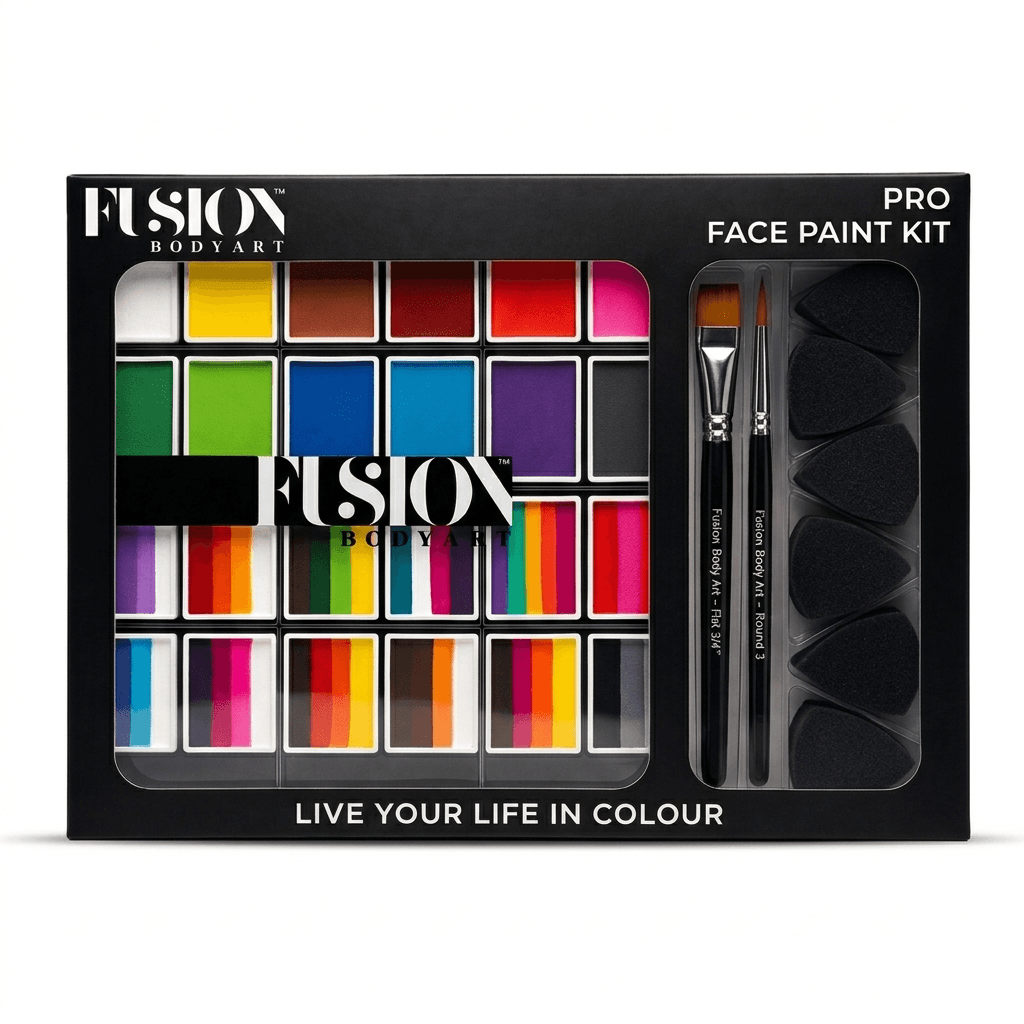
→ Fusion Pro Face Paint Kit — The complete professional starter kit.
→ Fusion One Stroke Palette – Rainbow Paradise — Twenty-four split cakes for professional event painting.
→ Fusion Unicorn & Fairy Face Painting Kit — Themed palette for children's parties.
Browse the full range at fusionbodyart.com


