


How to Face Paint a Butterfly: Leanne Courtney's Step-by-Step Tutorial
The butterfly face paint is the most requested design at children's events — universally loved, fast to paint with the right technique, and endlessly adaptable in colour and style. In this tutorial, Leanne Courtney walks through her butterfly face paint technique using her Princess Petal Palette by Fusion Body Art — the palette she designed specifically for butterfly, princess, fairy, and flower designs.
What You Need
| Product | Role in the Design |
|---|---|
| Leanne's Princess Petal Palette | The primary palette — 3 large petal cakes for sponge base work, 6 mini split cakes for brush detail and edging |
| Fusion Petal Sponges | Wing base application — stamps the butterfly wing shape with multiple colours in a single press |
| Leanne's Rainbow Round 3 | Dots, antennae, and fine detail |
| Leanne's Filbert Brush or Leanne's 3/8 Inch Angle Brush | Edging and wiggle-line decoration — Leanne's preferred brush for wing edges and flower petals. The 3/8 inch angle is a strong alternative for the same edging technique. |
| Fusion Clear Mist Spritzer Bottle | Activating the petal cakes and sponge |
| Clean water container | Brush rinsing and activation |
Leanne's Princess Petal Palette
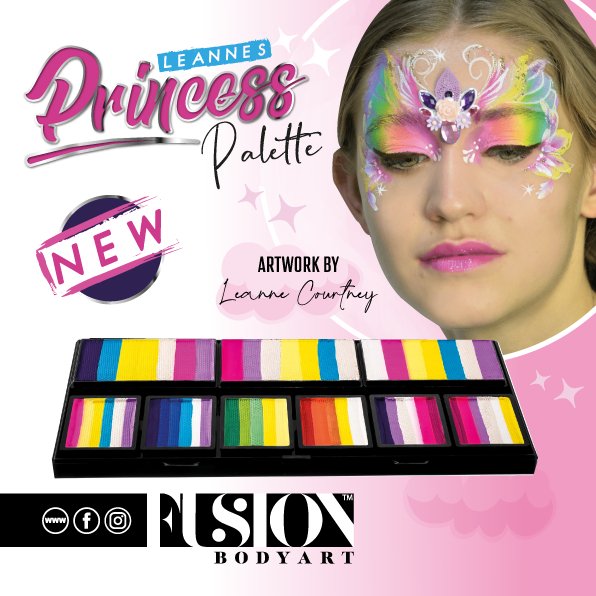
The Princess Petal Palette was designed by Leanne Courtney specifically for butterfly, princess, fairy, and flower designs. It contains 3 Petal Cakes and 6 mini split cakes in a portable palette case — organised so the large cakes work with a petal sponge for base coverage, and the smaller cakes work with a flat brush for one-stroke detail and edging.
A Petal Cake is similar to a split cake, but designed so both ends can create different designs — the lighter end picks up for highlights and edging, while the fuller colour in the centre and opposite end is used for base coverage and bold strokes. This means one Petal Cake gives you multiple design possibilities without needing to switch between separate products.

What's in the Palette
| Cake | Size | Primary Use | Best Designs |
|---|---|---|---|
| Leanne's Happy Rainbow | Large (25g) | Petal sponge base | Rainbow butterflies, rainbow crowns, flower bases |
| Leanne's Boho Princess | Large (25g) | Petal sponge base | Butterfly wings in soft pastels, princess and fairy faces |
| Leanne's Cotton Candy | Large (25g) | Petal sponge base | Pink and lilac butterfly wings, fairy designs |
| Leanne's Cupcake | Mini (10g) | Flat brush — detail | Flowers, edging, cheek art |
| Leanne's Dolphin Splash | Mini (10g) | Flat brush — detail | Ocean-themed designs, cool-toned edging |
| Leanne's Fairy Garden | Mini (10g) | Flat brush — detail | Green leaf and vine details, fairy designs |
| Leanne's Flaming Tiger | Mini (10g) | Flat brush — detail | Quick cheek art tigers and foxes |
| Leanne's Rose Bud | Mini (10g) | Flat brush — edging | Rose petal details, butterfly edging — the white end is Leanne's preferred edging pick-up |
| Leanne's Frangipani | Mini (10g) | Flat brush — detail | Tropical flowers, warm-toned designs |
New to Fusion Body Art? Learn how water-activated face paint works: Water Activated Face Paint — Complete Guide
How to Load the Petal Sponge
The Fusion Body Art petal sponge is the primary tool for the butterfly wing base. Loading it correctly is what gives the wings their shape and colour gradient in a single press.
- Spritz the large petal cake two or three times with the Clear Mist Spritzer Bottle. You want the surface activated and slightly damp — not running.
- Press the flat face of the sponge across the cake from side to side, picking up all the colour bands evenly. Do not drag the sponge — press and lift to build the load.
- Check the sponge face — you should see all the colour bands from the cake visible across the sponge surface. If there are gaps, do another loading pass.
- Do not over-wet the sponge — if water is transferring from the sponge to the cake surface, the sponge has too much moisture. Blot it lightly and reload.
Step by Step: Painting the Butterfly
Hold the loaded petal sponge at approximately 45 degrees to the face and press it above and to the outside of one eye — the widest point of the top wing sits level with the brow, the tip of the sponge points toward the bridge of the nose. Press firmly and lift cleanly. Repeat on the other side. The sponge shape gives you the wing form automatically. For a detailed guide on loading split cakes and petal cakes with a sponge, see our complete split cake guide.
Reload the Fusion Body Art petal sponge if needed. Rotate it and stamp below each eye — smaller than the top wing, angled so the point again directs toward the inner corner of the eye. There should be a small gap between the top and bottom wing on each side. Four stamps total and the butterfly shape is in.
This is the technique that sets Leanne's butterfly apart from a standard sponge design. Load the filbert brush — or Leanne's 3/8 inch angle brush as an alternative — with a small amount of paint from the wing base colour, then pick up just a little of the white from the light end of the Rosebud mini cake. Working along the outer edge of each wing, apply short up-and-down wiggle strokes — not a clean outline, but a decorative, slightly uneven edge that gives the wing texture and movement. Do not press too hard and keep the brush slightly damp rather than heavily loaded.
This replaces the standard black outline used in most butterfly tutorials, giving a softer, more elegant finish that suits the Princess Palette's colour combinations.
Load the filbert brush or the 3/8 inch angle brush with the white from the Rosebud or Fairy Garden mini cake, wet the tip slightly, then dip just the tip into the blue edge of Dolphin Splash and then into the pink edge of Cupcake. This is the double-dip — two quick dips that place lilac-pink on the brush tip without mixing the whole brush load. Stamp five-petal flowers on the wings by pressing the brush down at each petal position and lifting. Three petals angled downward, two above. Then rotate the brush sideways and pull a small upward stroke to add a centre accent.
Switch to the Round 3 brush. Using white paint from the end of the Rosebud or Cotton Candy cake, paint a simple elongated oval down the centre of the nose for the butterfly body. Load the round brush with a creamy consistency and dot along the wing edges — press and lift cleanly for each dot rather than drawing circles. For the antennae, press the brush tip at the top of the forehead, push it slightly, and lift to create a teardrop shape, then curve it outward. Two antennae, balanced on each side above the body.
If the double-dip flower looks too light, wet the brush tip and go back into Dolphin Splash (blue) then Cupcake (pink) again to strengthen the colour. Lean's approach is to go back over the centre petals with the stronger colour — pulling the brush inward toward the flower centre lifts and deepens the colour instantly. White highlights placed over the flower centre with the round brush add the final contrast.
Leanne's Beginner Tips for Butterfly Face Paint
- Angle the sponge at 45 degrees to the face. The 45-degree stamp is what gives the butterfly wing its correct orientation — the point of the sponge naturally directs toward the inner corner of the eye, which is the focal point all the wing shapes should work toward.
- Use the end colours of the cakes for edging. You do not need a separate white or black for most Princess Palette designs. The light end of the Rosebud cake picked up on the filbert brush gives you a soft white edge that complements the wing colours rather than outlining against them.
- Less line work is more for beginners. The sponge technique gets you 80% of the way there. Resist the urge to add heavy black outlines — a simple wiggle-line edge and some white dots is a complete, professional-looking butterfly without needing confident linework.
- The double-dip saves colour-mixing time. Rather than blending colours on a palette, the double-dip puts two colours on the brush tip in seconds. Dip into blue, dip into pink — the brush tip carries both and they blend on the skin naturally as you stamp each petal.
- Paint loosely — it is Fusion Body Art face paint, not a canvas. Leanne paints freely even when demonstrating on herself facing backwards in a mirror. Slight imperfections in petal shapes and wing edges are invisible from any normal viewing distance and add natural variation to the design.
- A wet brush picks up colour faster. When the mini cake colours feel dry or unresponsive, wet the brush tip slightly and make a loading pass before applying. The moisture reactivates the surface quickly.
What Else Can You Paint with the Princess Palette?
Leanne designed the Fusion Body Art Princess Palette to cover a full children's event design menu from a single product. The butterfly face paint tutorial demonstrates the core technique — sponge base with petal cakes, detail with mini cakes — that works across all of these designs:
| Design | Primary Cakes | Technique |
|---|---|---|
| Butterfly (full face) | Boho Princess or Cotton Candy (large) + Rose Bud (edging) | Petal sponge × 4 stamps, filbert edging, double-dip flowers |
| Rainbow butterfly | Happy Rainbow (large) | Petal sponge × 4 stamps — the rainbow graduates across the wings automatically |
| Flowers and roses | Rose Bud + Frangipani (mini) | Flat brush, one-stroke petals, filbert centre detail |
| Rainbow crown | Happy Rainbow (large) | Single arched flat brush stroke across forehead, small flowers at ends |
| Tinkerbell / fairy wings | Cotton Candy or Boho Princess (large) | Petal sponge stamped for wing shape, fairy garden green for details |
| Dolphin | Dolphin Splash (mini) | Flat brush one-stroke body shape, round brush detail |
| Quick cheek art tiger / fox | Flaming Tiger (mini) | Load a small amount of orange and yellow with flat brush, two ear strokes, quick stripes |
Frequently Asked Questions
How do you face paint a butterfly for beginners?
For beginners, the petal sponge is the fastest route to a good butterfly face paint. Load the sponge across the large petal cake, then stamp it at 45 degrees above and below each eye — four stamps for four wings. Add a white body down the nose centre and a few dots for the antennae. Keep line work minimal — less is more for beginners, and the sponge produces impressive results without needing brush control for the wing shapes.
What paint do you use for butterfly face paint?
Leanne Courtney uses her Princess Petal Palette by Fusion Body Art — 3 Petal Cakes and 6 mini split cakes designed for butterfly, princess, fairy, and flower designs. The large petal cakes are used with a petal sponge for the wing base. The smaller mini cakes are used with a flat brush for the double-dip flower detail and edging. White is picked up from the light end of the Rose Bud mini cake rather than needing a separate white.
What is the double-dip flower technique?
The double-dip flower is where you load a brush with one colour, then dip just the tip into a second colour before stamping. Leanne dips into blue (Dolphin Splash) and then into pink (Cupcake) to create a lilac-pink colour on the brush tip, then stamps five-petal flowers. The two colours blend naturally at the tip, creating variation in each petal without needing to mix paints on a palette.
What brushes do you use to face paint a butterfly?
Leanne uses her filbert brush for edging and the double-dip flower work — a brush she designed with a flat, rounded tip that produces smooth wiggle-line edges and petal shapes. The Leanne's 3/8 Inch Angle Brush is a strong alternative for the same edging technique, with the angled tip giving good control along curved wing edges. The Leanne's Rainbow Round 3 handles dots, antennae, and fine white detail. A petal sponge replaces a flat brush for the wing base.
How do you edge a butterfly without black outline?
Leanne's edging technique picks up a little white from the light end of the Rose Bud mini cake onto the filbert brush and applies short wiggle-line strokes along the outer wing edge. This creates a soft, decorative edge using the palette colours already in front of you — no separate black paint required. The result is gentler and more suited to the Princess Palette's pastel colour combinations than a hard black outline would be.
How long does it take to face paint a butterfly?
Using the petal sponge approach, a basic butterfly face paint takes under 2 minutes once practised. Four sponge stamps for the wings, edging strokes, double-dip flowers, dots, and antennae add 30 to 60 seconds depending on decoration level. For high-volume events, the design can be kept to its fastest version — sponge base, light edging, two dots — and completed in well under 90 seconds.
What is Leanne's Princess Petal Palette?
Leanne's Princess Petal Palette is a face painting palette by Fusion Body Art designed by Leanne Courtney. It contains 3 large Petal Cakes (25g each) used with a petal sponge for base work, and 6 mini split cakes (10g each) used with a flat brush for one-stroke detail. It is designed so the edge colours of each mini cake work as natural outliners, covering most princess, butterfly, fairy, and flower designs from a single palette.
What designs can you paint with the Princess Palette?
Leanne Courtney designed the Princess Palette to cover a full event design menu from one product — butterflies, rainbow crowns, flowers, fairy wings, dolphin designs, Tinkerbell, princess faces, and quick cheek art tigers and foxes using the Flaming Tiger mini cake.
Shop the Products Used in This Tutorial
All products used by Leanne Courtney in this tutorial are available from Fusion Body Art:
→ Leanne's Princess Petal Palette — 3 Petal Cakes and 6 mini split cakes for butterfly, princess, fairy, flower, and rainbow designs
→ Fusion Petal Sponges 6 Pack — the primary applicator for the butterfly wing base
→ Leanne's Rainbow Round 3 — for dots, antennae, and fine white detail
→ Leanne's 3/8 Inch Angle Brush — alternative to the filbert for edging and double-dip flower work
→ Fusion Clear Mist Spritzer Bottle — for precise activation of the petal cakes
Browse Leanne's full collection at fusionbodyart.com
Also by Leanne Courtney: How to Face Paint a Tiger: Leanne Courtney's Step-by-Step Tutorial


